
Dial Square
The Problem of The Quadrature
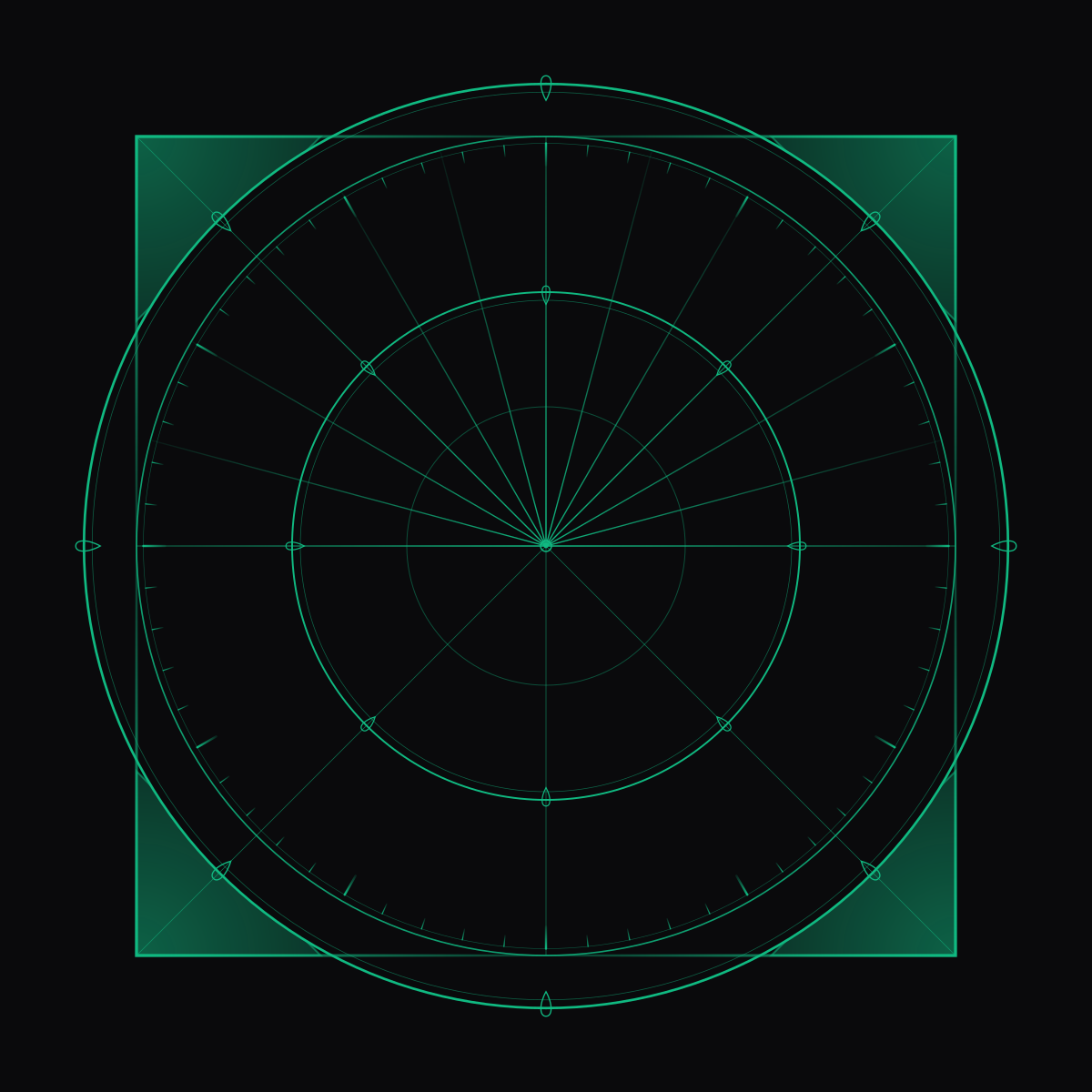
On Earth as It Is in Heaven
Our Father, which art in heaven,
Hallowed be thy Name.
Thy kingdom come.
Thy will be done,
In earth as it is in heaven.
Give us this day our daily bread.
And forgive us our trespasses,
As we forgive them that trespass against us.
And lead us not into temptation;
But deliver us from evil:
For thine is the kingdom,
The power, and the glory,
For ever and ever.
Amen.~ The Lord's Prayer
Language begins with symbols. The word symbol comes from the Greek súmbolon, meaning a 'mark'. It combines sym- (together) with -bol (throw) to give us 'thrown together'.
The two basic symbols of humanity across our various cultures are the circle (or the dial) and the square, each representing a realm. Between them, humanity, in the middle kingdom of civilization, has sought to negotiate reality.
- The Circle represents heaven, eternity, the spirit, and the infinite (the Singularity or the unbroken source)
- The Square represents earth, matter, the four cardinal directions, temporal bounds, and finite physical structure
Where the circle represents value, the square is a utility we call price. Their successful negotiation yields balanced and sustainable outcomes in civilization.
Ordinance and Ordnance
Looking out at the world with its various communities asserting themselves in ecumenical and material terms, this has been the eternal challenge since the beginning of culture: to reconcile meaning in symbols, starting with those two basic ones representing the ethereal and the material.
To 'square the circle' is to reconcile the two opposing dimensions of heaven and earth so we might come together and live with pragmatism, skill and yet still virtue in society.
Long ago, with our basic needs met, we began to explore the world of ideas and how to solve, using symbols, the various problems that rose out of the complexity of civilization. Squaring the circle, which is to arrive mathematically at a circle's equivalent square (i.e. one of the same surface area), is known as the problem of the quadrature. Generations of hobbyist philosophers and scientists tried to solve it using strictly Euclidean tools, a compass and an unmarked straightedge, perhaps believing that it was the gate through which a map of meaning might at last be discovered. In some ways that is what happened. Calculating $\pi$ became one of the kernels around which we developed computing and ultimately artificial intelligence, and with it a way to co-ordinate.
They never solved it because it's mathematically impossible. In 1882, over two millennia later, the German mathematician Ferdinand von Lindemann proved that $\pi$ is a transcendental number, meaning its exact value cannot be captured by any finite algebraic equation. Because $\pi$ is transcendental, its square root lies forever beyond the reach of a compass and straightedge, making a Euclidean construction of the quadrature impossible. This is somewhat like trying to make a motion picture with cave-painting technology. The one place where motion pictures were available to the caveman, however, was the dreamscape, and it is from here, through the subconscious mind of allegory and metaphor, as well as the imagination with which we bring interesting ideas to each other, that we are inspired to move one step beyond.
In 1886, four years after Lindemann's proof, the workers at Dial Square (a workshop of the Royal Arsenal, where the weapons of British imperial power had been manufactured for generations) formed a football team. It offers a fitting real-world metaphor: a movement, however imperfect, from the indiscriminate violence of the battlefield towards a proxy contest, played with rules and within clearly defined boundaries governed by an entrusted third-party referee.
Half a century later, computing arrived, and Alan Turing conceptualized the state machine: an architecture designed not to stall in an infinite loop trying to capture the unachievable, infinite length of a transcendental argument, but to humbly take the minimum amount required. By setting the required parameter of precision (the denomination of decimal places), the ancient geometry of the quadrature was finally solved computationally.
By 1949, the ENIAC (the world's first general-purpose electronic computer, built for the U.S. Army at UPenn) managed the feat of squaring the circle in a gruelling seventy hours of machine time. A decade later, IBM shattered that baseline: in 1958, an IBM 704 mainframe computed 10,000 decimal places in just 1.7 hours. Three years earlier, in 1955, IBM France had adopted the word ordinateur for 'computer', coined by the Sorbonne philologist Jacques Perret from an old term for God who sets the world in order, as if to presage the network and our capacity to order and sequence signals. The Cold War offered a semblance of peace and now we were working on order. Soon enough we will have good governance in place of government.
Today, modern AI can conjure a rendering encapsulating the entire philosophy of that mathematical milestone in mere seconds, but you have to know why it matters.
Time and Energy
Computing is expensive. We say that time and energy amount to money, but for whom? Perched above the Dial Square workshop was a square sundial; that's what a dial square is. The sundial, an ancient computer created when the complexity of civilization began to require punctuality, tells time. However, each sundial provides a different reading, such that even two that are only a metre apart will vary: at the equator, two identical sundials one metre apart will differ by approximately 2.16 milliseconds.
This makes the Dial Square a perfect metaphor to represent identity, for we can never be, nor see the world from, another's vantage. Not precisely, nor they from ours. In fact, to get a sound read on value and how it relates to price, we need as many points of reference and perspectives as possible.
Capital, particularly for the wealthy, has always been mobile. Labour, however, which has never enjoyed that luxury, no longer requires it. All it requires is peace, order and good governance, wherever it is, to create value, make a meaningful contribution to the world and live the good life.
This series consists of three subsequent pieces that extend the metaphor to help explain how the truth of our digital persona and its analogue in the material world, reputation or social credit, is constructed as a tel – the Stone Rose, an instantiation of the square – whose transactions are mediated through a utility (Our Glass) to generate wholesome and fair outcomes in our ecology – the Yoga Element, an instantiation of the circle.
The square in our general ontology is represented as veritas (satyam), while the circle is firmitas (sundaram). Between those two is the transformational element of utilitas (shivam). The regenerative output is a positive-sum yield, the result of bringing these together with governance (Regnum Dei). This is done through a constant flow of intelligence (liveness) and the cumulative outcome of applying that liveness to work (capital). In Eastern mythology this flow is known as ki or prana, whose Judeo-Christian equivalent is ruach, the Holy Spirit.